

Confidential Computing (CC) has transitioned from a niche security technology to a strategic imperative for protecting data in use. However, CC is not a singular, monolithic security control; its hardware-backed capabilities can be adopted on a server, across the network, and integrated directly into workloads. Ultimately, the security benefits of Confidential Computing increase with the level of integration.
White Papers & Reports
Unlocking the Future of Data Security: Confidential Computing as a Strategic Imperative
The Confidential Computing Consortium (CCC) has released new IDC research revealing that Confidential Computing is rapidly becoming a strategic imperative for secure AI, data collaboration, and regulatory readiness. Based on insights from 600+ global IT leaders, the study finds that 75% of organizations are now adopting Confidential Computing, driven by rising security threats, data sovereignty requirements, and the need to protect data in-use.

Introducing the Messaging Guide for Confidential Computing
AUTHORED BY CONFIDENTIAL COMPUTING CONSORTIUM
Adopting on-demand computing for sensitive and private workloads is critical in today’s interconnected and data-driven world. We need simple, fast, and reliable security mechanisms to protect data, code, and runtimes to achieve this. The Confidential Computing Consortium’s new Messaging Guide is a comprehensive resource that explores how Confidential Computing (CC) addresses these challenges and supports organizations in securing their workloads.
The Case for Confidential Computing
AUTHORED BY CONFIDENTIAL COMPUTING CONSORTIUM
Regardless of the industry, business, or company size, today’s business leaders must confront the data challenge: how to safely and securely collect, curate, and use company and customer data without compromising privacy, all the while maintaining strict compliance with regulations and industry-specific laws. And with the rise of artificial intelligence (AI) and AI / machine learning (ML) and the immense data requirements to fuel those initiatives, the challenge grows even more urgent.
As more companies and open source projects begin to use similar terms to describe similar paradigms that build upon hardware-based, attested Trusted Execution Environments (TEEs), it will be increasingly important that vendors use consistent terminology that describes the ways in which these new capabilities are applied within different functional domains.
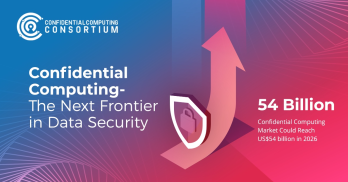
Confidential Computing: The Next Frontier in Data Security
AUTHORED BY EVEREST GROUP
The Everest Group leveraged multiple sources of data including proprietary datasets, consultations with key market stakeholders, and contributions from the members of the Confidential Computing Consortium to assess the market. Findings from the market study by Everest Group show the Confidential Computing market is projected to grow at a CAGR of 90%-95% to reach US$54 billion in 2026.
A Technical Analysis of Confidential Computing v1.3
AUTHORED BY CONFIDENTIAL COMPUTING CONSORTIUM
In classical computing, data exists in three states: in transit, at rest, and in use. Data traversing the network is “in transit,” data in storage is “at rest,” and data being processed is “in use.” In a world where we are constantly storing, consuming, and sharing sensitive data – from credit card data to medical records, from firewall configurations to our geolocation data – protecting sensitive data in all of its states is more critical than ever.
Confidential Computing: Hardware-Based Trusted Execution for Applications and Data
AUTHORED BY CONFIDENTIAL COMPUTING CONSORTIUM
Today, data is often encrypted at rest in storage and in transit across the network, but not while in use in memory. Additionality, the ability to protect data and code while it is in use is limited in conventional computing infrastructure. Organizations that handle sensitive data such as Personally Identifiable Information (PII), financial data, or health information need to mitigate threats that target the confidentiality and integrity of either the application or the data in system memory.


