TL;DR — What’s in This Issue
- Google Cloud announced new Confidential VM support (G4 & C4) featuring NVIDIA Blackwell GPUs and Intel 6th Gen Xeon processors to secure AI workloads.
- A modernized CCC website and customer experience project is underway, targeting a June rollout.
- Gramine and Enarx completed annual reviews, with Gramine expanding its scope to Intel TDX VM isolation.
- The Trustworthy Workload Identity (TWI) SIG is advancing IETF standards to help apps adopt CC without rewriting identity layers.
- New case studies were released from TikTok (ManaTEE data clean rooms), Bosch (Hermetik data sharing), and Symphony (secure financial collaboration).
- The 2026 Academic Research Grant program opens May 1st, and registration is open for the Open Source Summit NA and Confidential Computing Summit.
From the Executive Director
Hello Community Member,
After a very successful OC3 last month (see our March newsletter for details), the big news is that the CCC will be a Diamond Sponsor for this year’s Confidential Computing Summit at the Mint in San Francisco on 23-24 September, hosted by Opaque and the Linux Foundation. The Call for Proposals has already closed and the schedule should be announced shortly – so please head over to check it out.
As well as conferences devoted to Confidential Computing, I’m pleased to see increasing interest in Confidential Computing at industry events around the world. As well as CC appearing as a topic at blockchain and Web3 conferences (addressing use cases that appear to be gaining significant traction in those sectors), we’re seeing it turning up in other interesting places, as well: Open Source India (Mumbai, 16-17 June) has four separate sessions on different aspects of Confidential Computing.
We’re always looking to highlight Confidential Computing across the world, so if you’re aware of sessions, conferences, webinars or workshops where CC is featured, please get in touch! Equally, if you’re organising any sort of gathering or meet-up where the attendees might be interested in learning more about any aspect of Confidential Computing and how it can be used, please let us know: we love finding ways to spread the word!
From the Outreach Committee Chair
April bloomed bright with opportunities to reimagine the Confidential Computing Consortium website and overall customer experience. A new and modernized customer experience has been drafted and introduced to the consortium.There is a lot of excitement around this from multiple partners across the consortium. The goal is to see a complete redesign that can be rolled out in June.If you would like to provide insights, we welcome them! Contact either Rachel or myself to join this workstream.
The CCC Outreach session in OC3, Creating Global Standards for Confidential Computing, is now live on Youtube. Member companies from the Confidential Computing Consortium shared how they and their customers use Confidential Computing to enable their business:
- Symphony leverages Google Cloud Confidential Space to provide secure, cloud-native data processing and collaboration for financial institutions, ensuring that sensitive data remains isolated from the cloud provider and system administrators.
- Google is transforming digital advertising with Confidential Matching, utilizing TEEs to allow advertisers and platforms to match data and perform retargeting without either party ever gaining access to raw personally identifiable information (PII).
- Bosch introduced Hermetik, a trustworthy collaboration service built on Intel TDX that enables secure, multi-party data sharing and shared governance across the automotive, healthcare, and manufacturing sectors.
- Huawei showcased their Kunpeng AI solution, which extends Trusted Execution Environments to hardware accelerators like GPUs and NPUs, allowing for high-performance AI processing while maintaining full data protection.
- Super Swarm by Super Protocol is pioneering a standard protocol called “HTTPS for AI” that provides verifiable privacy for clinical AI and has demonstrated the ability to reduce complex compliance audit times from four weeks down to just two hours.
- TikTok shared their ManaTEE approach, an open-source two-stage data clean room that enables developers to build AI models using synthetic data before executing them against sensitive real-world data within a secure TEE.
Outreach Resources
- Post on CCC Jobs Board.
- Subscribe to CCC Monthly Newsletter and submit content via content submission form.
- Read CCC Blog Posts: submit your blog post ideas via content submission form
- Use the Member Badge and link to the CCC Website.
- Follow the CCC Events Calendar.
From the TAC
We had a productive April in the TAC. We’ve made progress on our enterprise integration blueprints and should have some of them published next month. We also featured annual reviews from two of the CCC’s longest-running projects, Enarx and Gramine. We also had a tech talk from one of our newest SIGs on trustworthy workload identity for replicated workloads.
Enarx remains the CCC’s only TEE-agnostic, WebAssembly-based runtime — a single workload binary that runs unmodified across SGX, SEV-SNP, and other TEEs. Richard Zak continues to maintain the project, and the TAC heard that companies are still actively reaching out about the TEE-agnostic, WASM-based isolation model Enarx pioneered. Anyone evaluating cross-TEE portability or looking to contribute should engage with the project — the architecture is differentiated and the door is open for new collaborators.
Kailun Qin and Mona Vij presented the Gramine annual review, with Don Porter. Gramine continues to see broad production adoption as the leading LibOS for lift-and-shift Linux workloads in TEEs. The project recently won the ACSAC Cybersecurity Artifact Award and has expanded scope from SGX process isolation to TDX VM isolation, reusing a substantial portion of its hardened LibOS to offer a tighter security footprint than general-purpose Confidential VMs (see the Gramine-TDX paper at ACM CCS). With a healthy user base and a clear technical roadmap, Gramine is well positioned for new contributors and sponsoring members to step in alongside the existing maintainers.
Tech Talk: Trustworthy Workload Identity for Replicated Workloads (April 16). Mark Novak (JPMorgan Chase), chair of the CCC Trustworthy Workload Identity (TWI) SIG, presented the SIG’s work on extending workload identity to replicated workloads — binding identities to attested workload instances using RATS-based remote attestation. The work feeds the IETF WIMSE draft (draft-ccc-wimse-twi-extensions) co-authored across JPMC, Arm, and Fraunhofer SIT, and is aimed at letting existing applications adopt Confidential Computing without rewriting their identity layer.
You can always find historical minutes, materials, and links to recordings in our governance repo.
Recent News
- At 2026 Google Cloud Next conference, Google has announced Confidential Computing support for G4 VMs in partnership with NVIDIA, featuring NVIDIA RTX PRO 6000 Blackwell Server Edition GPUs on Google Compute Engine (GCE) Confidential G4 VMs, available in preview globally, to help strengthen confidentiality and integrity for a wide spectrum of sensitive AI workloads. In partnership with Intel, Google is introducing the preview of C4 Confidential VMs, bringing Intel TDX to 6th Gen Xeon processors to help protect diverse AI and analytics workloads while providing industry-leading compute density and performance. Read more: https://blogs.nvidia.com/blog/google-cloud-agentic-physical-ai-factories/
- CCC members Invary, Anjuna Security, and Phala will present at Confidential AI Systems on May 6, a free virtual event exploring how enclaves, attestation, and AI agents work together to protect sensitive data. Register here.
- The CFP is now open for the CCC Academic Research Grant Program 2026. Up to two awards will support practical research advancing confidential computing, with focus areas including scalability challenges, privacy-focused applications, and security hardening and verification.May 1: Applications open | June 1: Applications close | July 1: Recipients announced. Learn more.
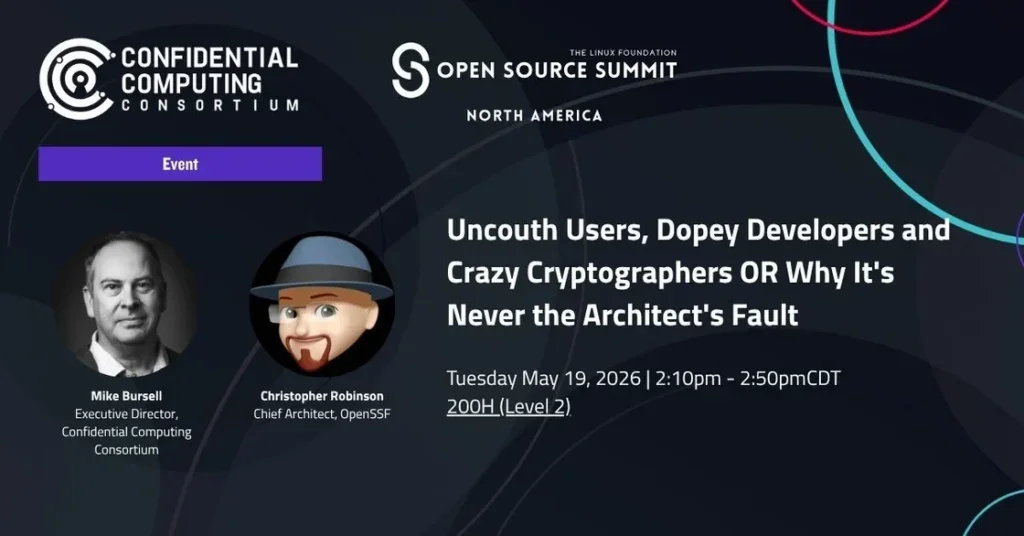
- CCC will be at Open Source Summit North America. Join Mike Bursell and Christopher Robinson (OpenSSF) for a session on the “taxonomy of personae” impacting security. Save $699! Use code SPRING when you register.May 19 | 2:10pm | Session details | Register now.
Secure AI will be a key focus at the Confidential Computing Summit, taking place June 23–24 in San Francisco. CCC is a Diamond Sponsor for this year’s event, which brings together global leaders working on privacy-preserving, production-ready AI.
Learn more and register.